Hard Rain Falling
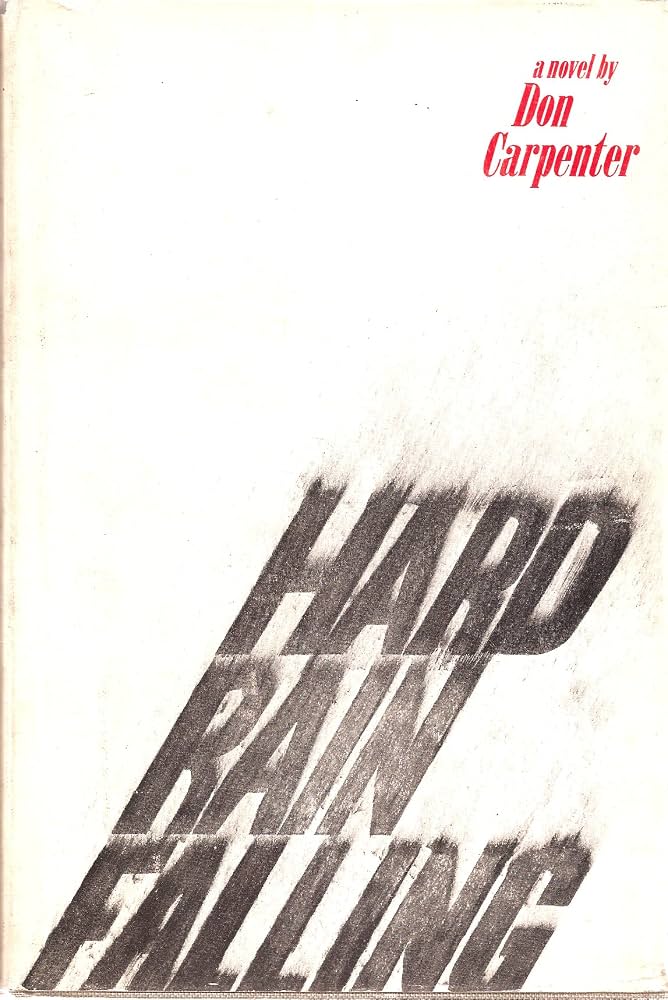
Don Carpenter's stunning debut novel touches on love, loneliness, and how difficult it can be to leave your past behind
To call Hard Rain Falling a crime novel would be doing it a disservice; the strength of this book is the way that Carpenter writes his characters. The book follows a few different characters’ perspectives, but mainly focuses on the life of Jack Levitt, an orphan who grows up without any role models and ends up getting himself into trouble. Jack is physically intimidating and quickly falls into a life of crime. One day in a pool hall in Portland, Oregon, he meets our other protagonist Billy Lancing, a mixed race boy a few years older than Jack who is exceptionally skilled at pool and is himself a hustler. They get talking, Jack secretly plans to rob Billy and dupe him out of his pool winnings, but holds himself back. Jack ultimately does break and enter into a home and later gets sent to prison.
We then spend a lot of time with Jack as he is transferred between various different prisons. He is put in solitary confinement, then later released and taken to a different correctional facility. It is here that he is reunited with Billy, who has also found himself down and out and in prison. They are cellmates and eventually enter into a relationship. Jack decides that love is the only way to move past the pain of abandonment from his parents and to leave behind his life of crime. He realises that he can love someone and be loved back and sees love as the force that may help him move beyond the abandonment that has shaped his life. Through Billy, he realises that he can love someone and be loved in return. Perhaps for the first time, he experiences a relationship that is not based on fear or violence. He begins to believe that his life might not have to continue along the path that was laid out for him.
Hard Rain Falling is not a book about redemption. I see it more as a book about people trying to escape their circumstances and be better, but unwittingly repeating the patterns that made them that way in the first place. Jack understands, at least partly, that his life cannot continue in the same way. After serving his sentence, he meets Sally, a wild woman from a wealthy background who is attracted to Jack’s bad-boy image. They settle down and have a son, whom Jack names Billy in honour of his special friend. He decides that loving another person is the way to change. He realises that much of his anger comes from his abandonment. But just understanding that isn’t enough for him to change. He desperately wants to become someone else, but has no role model and no idea of what that person should be like. So, even when he does find love, he can’t simply discard the rage, heartbreak and fear that have followed him for most of his life.
Billy’s story makes this even more painful. Both men are outsiders, but Billy has even fewer routes available to him, and the possibility of reinvention that Jack occasionally glimpses is much harder for him to reach. Billy’s race makes those limited possibilities even harder to reach. He is intelligent, clearly very talented and capable of making a living through playing pool, but rather than offering Billy a way out, this seems to trap him further in the world of hustling and crime.
What I liked about the novel is that Carpenter never asks us as the audience to excuse Jack or Billy for the things they do. Jack, in particular, can be cruel, violent, and destructive. But the novel is more interested in exploring why they are like this, and asks us to think about how much of their past experiences have caused this and the extent of the influence of nature versus nature on how our behaviour is shaped. It makes for a book that feels very real and I think that is why it had such a strong effect on me. I finished the novel still wondering if it is possible to leave your past behind, when your past is what has shaped almost everything about you.
Enjoyed this post? Subscribe to make sure you never miss a review.